🌍 Project Overview: The Ask
Global SuperStore was celebrating massive revenue milestones, yet executive leadership faced a glaring anomaly: profits were inexplicably shrinking. The primary objective of this project was to conduct an in-depth analysis of the global dataset to uncover the underlying causes of profit erosion across product categories.
🧹 Data Cleaning & Preparation
To find the ground truth, I isolated raw transactional data to pinpoint exact financial performance metrics. I processed and analyzed over 50,000 sales records, stripping away irrelevant columns and standardizing financial formats to ensure complete data integrity and analytical accuracy before building the baseline.
📊 Dashboard & Key Discoveries
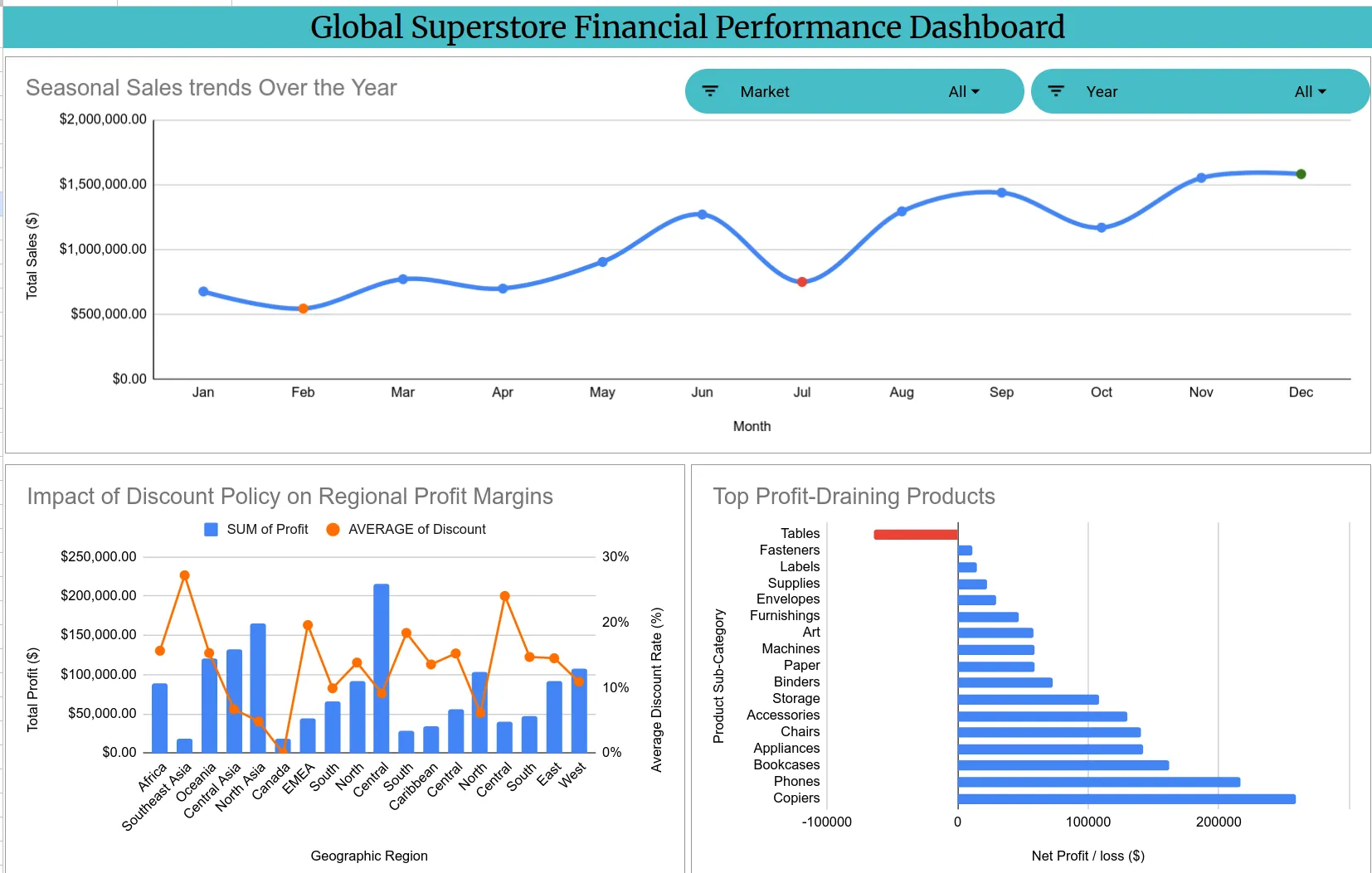
By examining the financial performance dashboard and data models, three critical failure points in the business model became instantly visible:
- Volume Does Not Equal Value (The Table Crisis): The Tables category generates a massive 64,000. It represents the only highly negative product sub-category in the portfolio, showing that sheer volume was masking pricing and logistical failures.
- The Discount Trap: Retail discount policies act as the silent killer of regional profit margins when left unchecked. For instance, Southeast Asia suffered collapsing profits due to an aggressive 27% average discount rate, while Central Asia maintained excellent profitability with a disciplined 7% discount rate.
- The Market Rhythm (Seasonal Trends): Sales peak dramatically in Q4 (November and December) while suffering a severe slump in mid-year (July). This indicated that capital was being tied up in stagnant mid-year dead stock rather than maximizing the Q4 peak.
🚀 Strategic Recommendations & Resolution
Data is only as valuable as the decisions it drives. Based on the evidence uncovered, I proposed a three-pillar strategy to immediately stop the profit erosion:
- Pricing & Logistics: Renegotiate international shipping contracts for heavy items like tables, or adjust their pricing model to absorb the shipping costs.
- Discount Cap: Implement a strict discount cap of 10% - 15% in underperforming global regions to instantly recover lost margins.
- Inventory Strategy: Drastically reduce procurement orders before the July slump, redirecting capital to ramp up inventory scaling in late summer to prepare for the Q4 peak.
High sales volume must be paired with strategic pricing and disciplined discounting to ensure true profitability.
🔗 Project Repository: View Full Source Code and Data on GitHub