🔍 Project Overview: The Aerodynamic Noise Challenge
In modern aeronautics and high-performance automotive engineering, aerodynamic noise is a critical design constraint. As air flows over an airfoil—like an aircraft wing or a turbine blade—turbulence interacts with the trailing edge, generating self-noise.
Testing every new wing prototype inside an acoustic wind tunnel is expensive, time-consuming, and resource-intensive.
The Solution: This project builds a scalable Machine Learning Pipeline using Apache Spark (PySpark). By leveraging historical wind tunnel data from NASA, the pipeline processes raw aerodynamic measurements and trains a predictive model to estimate the Sound Pressure Level (in Decibels) of an airfoil before it is ever physically manufactured.
⚙️ Architecture & ETL Workflow
To ensure the solution can scale from thousands to millions of sensor readings in a distributed environment, the entire workflow is engineered using PySpark SQL and PySpark MLlib.
- Extraction: Ingested 1,522 rows of raw telemetry data (CSV) detailing frequency, angle of attack, chord length, free-stream velocity, and boundary layer thickness.
- Transformation (Spark ETL): Executed strict data quality checks, deduplication (
dropDuplicates), and null removal (dropna), resulting in 1,499 clean records. The optimized dataset was saved as Apache Parquet for columnar storage and faster I/O performance. - Feature Engineering: Built a robust Spark ML Pipeline using
VectorAssemblerto consolidate input features, andStandardScalerto normalize parameters with drastically varying scales (e.g., frequencies in thousands of Hz vs. displacements in thousandths of a meter).
📊 Investigative Data Story & Key Findings
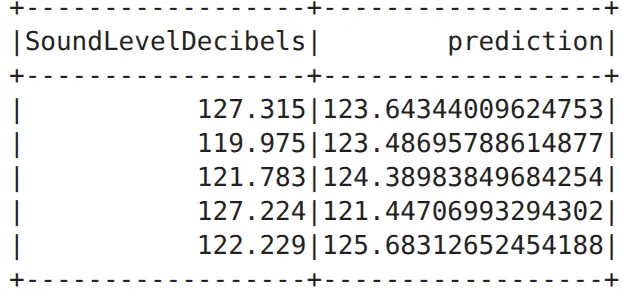
The preprocessed data was split (70/30) to train a multivariate LinearRegression model. The resulting model successfully maps physical constraints to acoustic outputs, revealing the core drivers of airfoil noise.
1. High Accuracy on Unseen Data
The model achieved a Mean Absolute Error (MAE) of 3.73 dB, meaning its predictions deviate by less than 4 decibels from actual physical wind tunnel measurements. The linear baseline explains 54% () of the variance in acoustic noise across diverse aerodynamic regimes.
2. The Primary Noise Drivers
By inspecting the learned weights of the standardized model, we extracted physical engineering insights:
- Velocity Increases Noise:
FreeStreamVelocity(+1.5789) is the primary positive driver. Faster airflow directly increases kinetic energy and turbulence intensity, raising noise levels. - Frequency Damping:
Frequency(-3.9728) is the strongest inverse driver. Higher acoustic frequencies damp out faster, exhibiting lower sound pressure levels. - Size and Geometry: Larger
ChordLength(-3.3818) shifts the acoustic spectrum, effectively reducing high-frequency trailing-edge noise.
🚧 Roadblocks & Data Caveats
- Linear Limitations: While the linear regression model established a strong baseline, fluid dynamics and turbulence are highly non-linear phenomena. The current model might under-predict extreme turbulent anomalies.
- Dataset Scale: The NASA dataset (1,499 rows post-ETL) is relatively small for Big Data tools. However, using PySpark ensures that this exact architecture can instantly scale to process terabytes of real-time sensor data from physical wind tunnels without any code changes.
💡 Strategic Recommendations
- Algorithmic Upgrade: Upgrade the ML Pipeline’s final stage from Linear Regression to a distributed non-linear model (like
RandomForestRegressororGBTRegressorin PySpark) to capture complex aerodynamic interactions and boost the score. - Real-Time Streaming: Integrate Apache Kafka with Spark Structured Streaming to predict airfoil noise in real-time as physical sensors stream data from the wind tunnel.
- API Deployment: Serialize the
PipelineModelinto a REST API (using FastAPI or Flask) to allow mechanical engineers to input design parameters and instantly receive Decibel predictions during the CAD prototyping phase.
🔗 Project Repository: View Full Source Code on GitHub